Tips for playing Cadgy
Cadgy grids typically have 10 "Basic" words without clues, and 10 rarer "Bonus" words with clues. On Fridays there are twice as many of each. It can be surprisingly hard to spot the words in such a small grid, but the hunt is rewarding. Every day you will learn something new and surprise yourself with what you already know. Here are a few tips for hunting more effectively.
Basic strategy
- When you find a word, look for other words that start with or end with the same letters. Very often there are prefixes and suffixes that some of the words have in common.
- Tiles turn gold when you've found every word that uses them, so the game gets easier as you approach the finish — and the last word is always "free." So save any Bonus words that you’re stuck on until the end. It's also good to get the Bonus words you do know out of the way first.
- Avoid guessing until you are stuck on a Bonus clue, as it wastes time. Accepted answers are always either Basic words, which are common words (never names) that you will recognize on sight; or Bonus words, which have clues. Not all proper names that you see will be accepted; only those that match a clue.
- Bonus word clues often have spelling hints or word-origin information if they're especially obscure. Read these; sometimes the answer is hiding in plain sight. An anagram is a rearrangement of the letters to form a new word and palindrome means that the word is spelled the same backwards as forwards.
A few secrets
- Bonus clues are listed in alphabetical order by the word they define. If you're unsure of a Bonus word, its position in the list hints at the starting letter.
- There's a "Shuffle" button above the grid that scrambles the tiles within each column. This can be helpful for getting a new perspective if you're stuck.
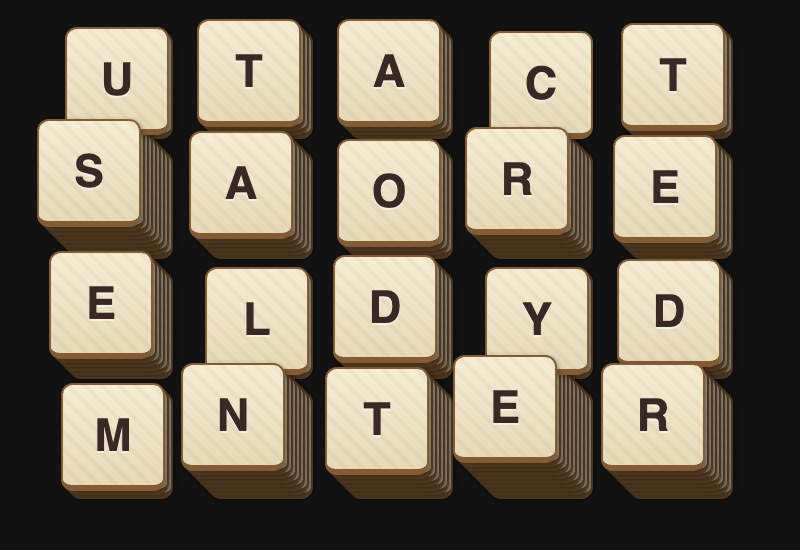
- The "3D" button above the grid toggles a mode that shows the grid as stacks of the remaining tiles, giving you a sense of how many of each letter are left. For example, in the grid below, there are many words left that begin with the letter "S", and not very many that begin with the letter "U". 3D mode is helpful for some players, but only marginally. Most players toggle 3D on briefly for a quick look, then switch back to flat mode.
Scoring
Your time and your guesses-per-word are reported to you after you find all the words. Lower is better for both. On a typical day only a few percent of players find the words in less than 3 minutes; only a few percent of players are flawless (1 guess per word); and only a few players, the cadgiest of the cadgy, accomplish both feats! But don't compare yourself to them; the mere fact that you are playing this game makes you above average in my book.
How I select Cadgy grids
I look for letter grids that have exactly 20 valid words hiding in them, with a nice balance of common and rare words. I draw on a variety of sources to measure word frequency and decide what counts as "valid" and "common" and "rare". The standard is closer to crosswords than to Scrabble, but all valid Scrabble words (OSPD list) are considered "valid", so any ordinary Scrabble word you find in the grid should be counted as either a Basic word or a Bonus word. Occasionally I'll exclude a Scrabble word that turns up no meaningful attestation online. If you guess one of these ghosts, it won't count as an invalid move.
"Bonus" words include higher-level vocabulary — the kind you might have first encountered in secondary school — but they can also venture outside the usual Wordle/Scrabble/Spelling Bee universe:
- Terminology specific to a field of study, hobby, industry, or culture
- Significant names and abbreviations
- Words from languages other than English, when they're commonly used in English-language contexts or otherwise notable
Sometimes simple words will guest star on the Bonus side if they fit with the day's theme.
While Scrabble words always count toward the 20, not every proper name or abbreviation you find in the grid will be counted — it depends if there's "room" for it after all the ordinary words are counted, and then it's a matter of editorial judgment whether the name is worth exploring that day. But again, you don't need to guess: Accepted proper names will always be on the "Bonus" side with a clue.
I wrote a newsletter article about how I do research for the notes that show up when you find the words.
Which English?
Cadgy players come from all over the Anglosphere and beyond. Cadgy words do, too. World travel is a key part of the experience: you'll encounter Americanisms, Canadianisms, British mining argot, New Zealand trees, Singlish interjections, Australian birds, South African township slang, and a lot of Scottish rural life. When a word skews regional, I try to say so in the clue or note. (Fair warning, though: I'm an American, so I'm probably not putting "(US)" on as many clues as I should.)